Showing posts with label Economic History. Show all posts

Monday, April 4, 2016

The Complete Works of Rosa Luxemburg


THE COMPLETE WORKS OF ROSA LUXEMBURG

Support the ongoing effort to produce:
The Complete Works of Rosa Luxemburg
The effort to issue The Complete Works of Rosa Luxemburg (issued by Verso Books) has reached a critical phase, and we appeal for your help in enabling future volumes to be published.
The Complete Works was inaugurated in March 2011 with the 600-page Letters of Rosa Luxemburg, the largest collection of her correspondence ever published in English. Volume I of the Complete Works, entitled Economic Writings 1, was published in 2013 and contains the first full English translation of one of her most important books, Introduction to Political Economy, as well as eight newly-discovered manuscripts on anthropology, economic history, and the theory of crises. Volume II, entitled Economic Writings 2, was published in 2015 and contains a new translation of The Accumulation of Capital and the Anti-Critique.
We are now raising funds to cover the costs of translation of her Political Writings, beginning with three volumes (Vols. 3, 4 and 5) devoted to “On Revolution.” They will contain all of her writings on the 1905-06 Russian Revolution, 1917 Russian Revolution, and 1918-19 German Revolution. These reveal Luxemburg at her finest—as a fierce supporter of revolutionary democracy, with a sensitive grasp of spontaneous freedom struggles as well as of non-hierarchical forms of organization. Many of these writings—a large number of them translated from Polish—have never appeared in print since their initial publication, and most have never before appeared in English.
The Complete Works will make her entire body of work available for the first time in any language. All of the writings will be newly translated, with the highest level of scholarly editing. But we cannot continue to commission translations without your support. We need to raise an additional $35,000 to help pay for the translation costs of the next three volumes.
We urge you to make a contribution to the Rosa Luxemburg page of the Toledo Fund, at https://toledo.nationbuilder.com/complete_works_rosa_luxemburg
There are few better ways of celebrating International Women’s Month!
—The Editorial Board, Rosa Luxemburg Complete Works.


***END***
‘Human Herbs’ – a song by Cold Hands & Quarter Moon: http://www.youtube.com/watch?v=Au-vyMtfDAs
Posted here by Glenn Rikowski
Glenn Rikowski @ Academia: http://independent.academia.edu/GlennRikowski 
Ruth Rikowski @ Academia: http://lsbu.academia.edu/RuthRikowski

Ruth Rikowski at Serendipitous Moments: http://ruthrikowskiim.blogspot.co.uk/

Sunday, December 6, 2015

CRISES? WHAT CRISES?


CRISES? WHAT CRISES?

Call for Papers for a Session on:
Crises? What Crises?
Society for Socialist Studies (SSS)
Congress of the Humanities and Social Sciences, 2016
University of Calgary
May 31 – June 3, 2016

Economists aren't sure the world economy ever got over the 2008/9 crisis but already warn of new financial and sovereign debt crises. Secular stagnation has become common parlance in economic circles.
Only environmentalists, pointing at climate change, the decline of biodiversity, water shortages and concomitant desertification, paint an even gloomier picture of the state and future of the world.
Not surprisingly, political scientists register a crisis of legitimation but also various crises of representation making it difficult for the discontented to articulate their concerns and mount movements for social and ecological change.
For the most parts, the left with its tradition of seeing itself as socialist heir of capitalist crises can't capitalize on the overabundance of such crises. The crisis of the left, one might think, is even deeper than the various crises of capitalism.
·         The session "Crises? What Crises?" invites papers discussing any of the following questions:
·         Which kinds of crises is capitalism facing these days? Crises of the economy, ecology, legitimation, representation and/or hegemony?
·         Do these crises affect only subsystems of capitalism or do they add up to an organic or general crisis of capitalism?
·         Are these crises structural or conjunctural?
·         What role could the left play in overcoming capitalist crises?
·         Is the left in crisis, too? If so, what kind of crisis is that and how might it be overcome?
Session organizer:
Ingo Schmidt, ingos@athabascau.ca

Paper titles and abstracts (maximum of 100 words) should be submitted by Friday, January 29, 2016.


Work on Crisis (and Education) by Glenn Rikowski:

Rikowski, G. (2014) Crises in Education, Crises of Education, A paper prepared for the Philosophy of Education Seminars at the University of London Institute of Education 2014-15 Programme, 22nd October 2014. Available at Academia: http://www.academia.edu/8953489/Crises_in_Education_Crises_of_Education

Rikowski, G. (2015) Crises, Commodities and Education: Disruptions, Eruptions, Interruptions and Ruptions, a paper prepared for the Research in Critical Education Studies (RiCES) Seminar, School of Education, University of Lincoln, 19th November 2105 (Revised 2nd December, 2015). Available at Academia: http://www.academia.edu/18511424/Crises_Commodities_and_Education_Disruptions_Eruptions_Interruptions_and_Ruptions

***END***
‘Human Herbs’ – a song by Cold Hands & Quarter Moon: http://www.youtube.com/watch?v=Au-vyMtfDAs
Posted here by Glenn Rikowski
Glenn Rikowski @ Academia: http://independent.academia.edu/GlennRikowski 
Ruth Rikowski @ Academia: http://lsbu.academia.edu/RuthRikowski
Ruth Rikowski at Serendipitous Moments: http://ruthrikowskiim.blogspot.co.uk/

All that is Solid for Glenn Rikowski: http://rikowski.wordpress.com


Thursday, October 8, 2015

Inventing the Future: Postcapitalism and a World Without Work


INVENTING THE FUTURE: POSTCAPITALISM AND A WORLD WITHOUT WORK
Nick Srnicek and Alex Williams
Book Launch
At Housmans

Housmans Bookshop, Peace House, 5 Caledonian Road, King’s Cross
London, N1 9DX
Tel: 020 7837 4473
e: shop@housmans.com
Wednesday 28th October, 7.00pm
Entry £3, redeemable against any purchase

Launch of Inventing the Future: Postcapitalism and a World Without Work
By Nick Srnicek and Alex Williams
Verso, 2015
ISBN-13: 978-1-78478-096-8 (paperback)

Despite the profound crisis of capitalism and the mass mobilizations of people around the world in response, there has been no successful contestation of neoliberalism’s hegemony. Inventing the Future is a major new manifesto that argues for a novel set of alternatives for the future—alternatives which seek to rekindle a popular modernity.

Against the confused understanding of the high-tech and neoliberal world by both the right and the left, this book claims that the emancipatory and future-oriented possibilities of our society can be reclaimed. Instead of running from a complex future, the authors envisage a post-capitalist economy is capable of advancing living standards, liberating humanity from work and developing technologies which free us from biological and environmental constraints.

Reviews

“Nick Srnicek and Alex Williams' project dares to propose a different way of thinking and acting. Given the fizzling of the Occupy moment, a radical rethinking of the anarchic approach is badly needed but just not happening. This book could do a lot of work in getting that rethink going.”
– Doug Henwood, author of Wall Street

“The Left has lost its grip on the future. In retreat from technological modernity, too many leftists have fled to the local, the organic and the spontaneous. Inventing the Future shows why these strategies are misguided, and offers a vision of how left-wing politics can be rebuilt for the 21st century.”
– Mark Fisher, author of Capitalist Realism: Is there no Alternative?

Housmans – radical booksellers since 1945: http://www.housmans.com/

***END***
‘Human Herbs’ – a song by Cold Hands & Quarter Moon: http://www.youtube.com/watch?v=Au-vyMtfDAs
Posted here by Glenn Rikowski
Glenn Rikowski @ Academia: http://independent.academia.edu/GlennRikowski 
Ruth Rikowski @ Academia: http://lsbu.academia.edu/RuthRikowski

Ruth Rikowski at Serendipitous Moments: http://ruthrikowskiim.blogspot.co.uk/


Friday, August 28, 2015

Will We Crash Again? Why Capitalism Needs Debt Write-offs to Survive

WILL WE CRASH AGAIN? WHY CAPITALISM NEEDS DEBT WRITE-OFFS TO SURVIVE
Conway Hall Ethical Society & London Futurists presents:
London Thinks – Will We Crash Again? Why Capitalism Needs Debt Write-offs to Survive
With STEVE KEEN
Tuesday 1st September @ 7:30 pm - 9:00 pm | £5 - £10
CONWAY HALL
25 Red Lion Square, London, WC1R 4RL United Kingdom
Mainstream economists failed to anticipate the great financial crash of 2007-8. In this talk, Professor Steve Keen will share his view on the bigger picture – including recent financial developments around the world. He will review options for the future of economics, highlight the little-understood importance of debt, and argue that significant debt write-downs are needed in order to limit future financial crashes.
Steve Keen is a Professor of Economics & Head of the School of Economics, History & Politics at Kingston University. He was one of the handful of economists to realise that a serious economic crisis was imminent, and to publicly warn of it, from as early as December 2005.
A staunch critic of mainstream economics, his book Debunking Economics is now in its 2nd edition and has been translated into Chinese, French and Spanish.
The event will be moderated by David Wood, Chair of London Futurists. The talk will be followed by audience Q&A.
A cash bar will be available at the event. Afterwards, there will be the chance to continue the discussion at a nearby pub.
Organised in partnership with the London Futurists
London Futurists hold regular speaker events to explore radical scenarios for the next 3-40 years.
For more details, see http://londonfuturists.com/.

***END***
‘Human Herbs’ – a song by Cold Hands & Quarter Moon: http://www.youtube.com/watch?v=Au-vyMtfDAs
Posted here by Glenn Rikowski
Glenn Rikowski @ Academia: http://independent.academia.edu/GlennRikowski 


Monday, June 29, 2015

DAVID MABB

DAVID MABB
At the William Morris Gallery
Lloyd Park, Forest Road
Walthamstow, London, E17 4PP
020 8496 4390 
London, United Kingdom
27 June to 27 September 2015

Open Wednesday to Sunday, 10am - 5pm; free

William Morris and Russian artist El Lissitzky both wanted to change people’s lives through their art. Whilst Morris saw beauty in the past, Lissitzky sought a new visual language for the future.

In his latest work, British artist David Mabb celebrates the utopian ideas of these two men through their seminal book designs: Morris's Kelmscott Chaucer and Lissitzky's For the Voice, a revolutionary book of poems by Vladimir Mayakovsky considered one of the finest achievements in Russian avant-garde bookmaking.

Comprising 30 canvasses, Announcer takes over the gallery space, interweaving and contrasting the two designs so that Morris and Lissitzky's graphic s are never able to fully merge or separate.

William Morris Gallery: http://www.wmgallery.org.uk/


***END***
‘Human Herbs’ – a song by Cold Hands & Quarter Moon: http://www.youtube.com/watch?v=Au-vyMtfDAs
Posted here by Glenn Rikowski
Glenn Rikowski @ Academia: http://independent.academia.edu/GlennRikowski 
All that is Solid for Glenn Rikowski: http://rikowski.wordpress.com

Thursday, May 28, 2015

Postgraduate Research Grants on European Public Finances

POSTGRADUATE RESEARCH GRANTS ON EUROPEAN PUBLIC FINANCES

Researchers with an interest in EU public finances are welcome to apply for a €5,000 grant to undertake a research visit to the Historical Archives of the European Union in Florence, Italy.  Two grants are available.

The grant programme is organised by the European Court of Auditors, in collaboration with the Historical Archives of the EU, on the campus of the European University Institute.

The European Court of Auditors has entrusted its own historical archives, and the archives of the Audit Board (1958-1977), to the Historical Archives of the EU in Florence.

Applications from economists, historians, lawyers and public-finance specialists are very welcome.

The deadline for applications is 15 June 2015.


***END***
‘Human Herbs’ – a song by Cold Hands & Quarter Moon: http://www.youtube.com/watch?v=Au-vyMtfDAs
Posted here by Glenn Rikowski
Glenn Rikowski @ Academia: http://independent.academia.edu/GlennRikowski 

All that is Solid for Glenn Rikowski: http://rikowski.wordpress.com

Thursday, June 19, 2014

Matchwomen's Festival

MATCHWOMEN’S FESTIVAL
Saturday 5th July 2014
Mander Hall
Hamilton House, Mabledon Place
London
WC1H 9BD
11AM to 9PM
Nearest stations: Euston and King’s Cross

The Legacy of the Matchwomen

In the summer of 1888, 1400 women walked out on strike over management bullying and appalling, hazardous working conditions. The women and girls working at Bryant & May’s match factory in London’s East End shocked the world, and ultimately changed it.

Working-class women at this time were supposed to be seen and not heard, especially if, like many matchwomen, they were of Irish heritage. Instead, the matchwomen paraded the streets of the East End, singing songs and telling the truth about their starvation wages and mistreatment by the firm.
They marched to Parliament, and their strength and solidarity won them better pay, safer conditions, and the right to form the largest union of women and girls in Britain.

They were an inspiration to other groups of workers up and down the country and throughout the world. The modern movement for workers’ rights had begun, and the matchwomen were at the forefront of it.

Last year's first Matchwomen's Festival marked the 125th anniversary of the Matchwomen's Strike.

It was a brilliant day with around 700 visitors, including the late Bob Crow, and was one of Tony Benn's last public engagements.

Since then, the importance of the matchwomen to British history has been acknowledged in Parliament with a debate devoted to them, and Labour MPs recommending that the book about them, Striking a Light, should be on the school syllabus. Minister Ed Vaizey replied that Michael Gove would read it: so far, no word on whether Mr Gove enjoyed it, but we wait with baited breath.

MPs also wanted to see a properly-worded blue plaque acknowledging the women’s courage at the old factory site, which Vaizey supported. Watch this space, or indeed, that space if you live nearby.

This year’s festival is smaller, but still perfectly formed. We have some wonderful speakers, songs from Tina McKevitt, and spoken word from Faisal Ali.

We’re excited to have the inspiring Sara Khan on the importance of making links with Muslim women, Sukhwant Dhaliwal on the work and history of Women Against Fundamentalism, eminent trade union and human rights barrister John Hendy QC, and the TUC's Scarlet Harris.

Kate Connelly will speak on her book about the astonishing life of Sylvia Pankhurst,

Terry McCarthy will speak about the matchwomen-inspired London Dock Strike of 1889, on which he is an authority. Actor and director Kate Hardie will talk about her film Shoot Me, and Alex Wall will talk about working with people with eating disorders, and how they can affect us all.

Heather Wakefield and Caroline Raine have excellent records on organising trade union women, and will update us on the latest issues and disputes and how we can support them.

Louise Raw is the author of Striking a Light and speaks and writes on the Matchwomen, women, unions and history.  Diana Johnson MP was instrumental in bringing the Matchwomen’s legacy to the attention of parliament.

Special Guest:
Eam Rin
We welcome to the festival a very special guest. Eam is at the forefront of the dangerous struggle for workers' rights in Cambodia, which has left 5 people dead this year alone. A garment sewer for 14 years and secretary of the Cambodian Democratic Union, Eam is visiting the UK to talk about the current brutal government crackdown on freedom of association.


Tickets are £2 each for the whole day through Eventbrite, plus a small booking fee.   

**END**

‘Human Herbs’ – a song by Cold Hands & Quarter Moon: http://www.youtube.com/watch?v=Au-vyMtfDAs

Posted here by Glenn Rikowski
Glenn Rikowski @ Academia: http://independent.academia.edu/GlennRikowski 
The Flow of Ideas: http://www.flowideas.co.uk

All that is Solid for Glenn Rikowski: http://rikowski.wordpress.com

Wednesday, March 5, 2014

Economics of the 1%

ECONOMICS OF THE 1%

Economics of the 1%: How Economics Serves the Rich, Obscures Reality and Distorts Policy
John F. Weeks
Imprint: Anthem Press
Paperback
ISBN 9780857281081
January 2014 | 246 Pages | 216 x 140mm / 8.5 x 5.5 | 20+ graphs

http://www.anthempress.com/ economics-of-the-1-percent

Today’s ‘doctrine of choice’ assures adults that they are competent to make serious personal decisions about healthcare, education and retirement plans. At the same time, most people are convinced that they are so ignorant of economics that they are not capable of holding an informed opinion, and that economic issues must be left to experts. The so-called experts of the mainstream economics profession claim to have profound, inaccessible knowledge; in fact they understand little and obscure almost everything.

Understanding the economy is not simple, but it is no more complicated than understanding the political system sufficiently to cast a vote. In straightforward language, John F. Weeks exposes the myths of mainstream economics and explains why current economic policies fail to serve the vast majority of people in the United States, Europe and elsewhere. He demonstrates that austerity policies have little theoretical basis and achieve nothing but inequality and misery. He goes on to explain how the current deficit and debt ‘crises’ in the United States and Europe are ideologically manufactured, unnecessary and simple to overcome. Drawing on examples from around the world, this book provides a bold alternative to the economics of the 1%. Their failure to serve the interests of the many results from their devoted service to the few.

John Weeks, an American living in London, is professor emeritus of economics at SOAS, University of London. He has advised numerous governments and written and commented widely on economic and social issues in the United States, Europe and developing regions.

Book Launch Lecture (from YouTube), SOAS, University of London, 3rd February 2014: http://www.youtube.com/watch?v=_8xKikh_g1w&feature=c4-overview&list=UUwlZZGmE1e_6PI2e-HOPOQw

Other Links (including interviews with John Weeks): http://www.anthempress.com/economics-of-the-1-percent

“The recent crisis has exposed the weaknesses of not only the business models of the capitalist world but also the flaws in mainstream economic thought. John F. Weeks’ polemic on the ‘Economics of the 1%’ explores these intellectual blind alleys and takes no prisoners. Pointing out holes in the mainstream logic, Weeks aligns himself with the tradition(s) of Karl Marx, John Maynard Keynes and Thorstein Veblen, and with such contemporaries as James K. Galbraith, Ha-Joon Chang and Paul Krugman. And Weeks is right. We have to replace ‘fakeconomics’ with proper economic analysis to combat the social inequalities that have grown disproportionately and dangerously in recent decades.” —László Andor, Economist and Commissioner for Employment, Social Affairs and Inclusion, European Commission

**END**

'Cheerful Sin' – a song by Victor Rikowski: http://www.youtube.com/watch?v=tIbX5aKUjO8

Posted here by Glenn Rikowski
The Flow of Ideas: http://www.flowideas.co.uk
Glenn Rikowski on Facebook at: http://www.facebook.com/glenn.rikowski

All that is Solid for Glenn Rikowski: http://rikowski.wordpress.com

Thursday, February 6, 2014

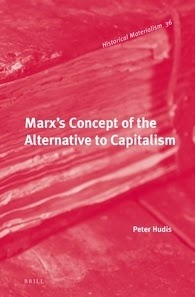
Marx's Later Writings on the Paris Commune and the Alternative to Capitalism

Peter Hudis
MARX’S LATER WRITINGS ON THE PARIS COMMUNE AND THE ALTERNATIVE TO CAPITALISM

SUNDAY, FEBRUARY 16, 2014
6:00-8:00 PM
Westside Peace Center
3916 Sepulveda Blvd., near Venice Blvd. (free parking in rear)
Suite 101-102, press #22 at door to get into building
Culver City (LA area)

Speakers:
MICHAEL PUGLIESE, longtime left observer
HYUNHO C., student activist

In his CIVIL WAR IN FRANCE, Marx pointed to the concrete measures taken by the Paris Commune, including the abolition of the state, as harbingers of a new form of radical democracy, communism.  He discussed the nature of that communism and the way it could be achieved in CRITIQUE OF THE GOTHA PROGRAM, where it would culminate in a society based upon the principle of from each according to their abilities to each according to their needs.  This and other aspects of Marx's writings bearing on alternatives to capitalism will be the subject of free and open discussion.

Suggested reading:
Ch. 4 of Peter Hudis’s MARX’S CONCEPT OF THE ALTERNATIVE TO CAPITALISM:  "Marx’s Later Writings on Post-Capitalist Society"
[Copies of book available at a discount at the meeting]

[This is the third in a series of meetings on this topic, in preparation for the author's visit to LA in March 16, when he will give an overview of his book and engage in dialogue]

See also the recently published book reviews by MARXIST-HUMANIST workers and intellectuals http://www.internationalmarxisthumanist.org/articles/marx-alternative-capitalism-review-symposium-karel-ludenhoff-marija-krtolica-dale-parsons  and from a sympathetic/critical ANARCHIST: http://www.anarkismo.net/article/26446   
Sponsored by the West Coast Chapter, International Marxist-Humanist Organization
Join our new Facebook page: "International Marxist-Humanist Organization" https://www.facebook.com/groups/imhorg/

**END**

'Cheerful Sin' – a song by Victor Rikowski: http://www.youtube.com/watch?v=tIbX5aKUjO8

Posted here by Glenn Rikowski
All that is Solid for Glenn Rikowski: http://rikowski.wordpress.com
The Flow of Ideas: http://www.flowideas.co.uk
Glenn Rikowski on Facebook at: http://www.facebook.com/glenn.rikowski

Glenn Rikowski at Academia: https://independent.academia.edu/GlennRikowski   

Monday, January 27, 2014

Organizing for the Post-Growth Economy

ORGANIZING FOR THE POST-GROWTH ECONOMY
ephemera: theory & politics in organization
Conference organizers: Ole Bjerg, Christian Garmann Johnsen, Bent Meier Sørensen and Lena Olaison
Conference date: 8-9 of May 2014
Conference venue: Copenhagen Business School, Denmark

Perpetual economic growth is an underlying assumption of the contemporary capitalist organization of society. The idea of growth is embedded not only in the corpus of economic thought but also in the institutions of the economy (Binswanger, 2013; Gorz, 2012). More recently, entrepreneurship, innovation and creativity have been seen as possible ways to solve the current economic and environmental crisis as well as to generate growth (Schaper, 2002). This is the case because entrepreneurship and innovation are portrayed as seeds of new initiatives and ideas that will boost economic development while simultaneously reduce its impact on the climate. Such a belief has produced new markets, such as carbon markets, and an emerging ‘climate capitalism’ (Böhm, Murtola and Spoelstra, 2012). At the heart of this logic is a faith in the individual economic actor, not least the entrepreneur, as a gifted individual with unique abilities (Shane, 2003). And it is evident that the current post-crisis discourse keeps its confidence in the emergent socially responsible economic actor who will contribute to the construction of a moral economy' (Arvidsson, 2013).
This ephemera conference seeks to question the feasibility, moral legitimacy and sustainability of perpetual economic growth. Although contested, current political and popular beliefs tend to hold that the twin crises of economy and ecology are merely temporary, exceptional phenomena and that the global economy will soon bounce back to business as usual. However, others have suggested that we are in the midst of a paradigm shift in the nature of capitalism (Heinberg, 2011). Instead of using our energies to prevent this shift from happening it may be more fruitful to appreciate the opportunities for reflection that are offered by the crisis. On the one hand, we should learn from history and see that the history of capitalism is indeed the history of revolutions. This suggests that we indeed may be at the brink of a new phase in society where we experience a change in the underlying structures. On the other hand, we can explore new forms of economic organization that do not rest upon the condition of growth (Schumacher, 1973; Latouche, 2009; Eisenstein, 2011). Even though the prerequisite of growth has been subjected to criticism within economic theory (Herrera, 2011), we need to further explore its implications. Taken together, the challenge is, in other words, to imagine what a sustainable post-growth economy might look like (Gorz, 1999; Seidl, 2010; Paech, 2012).
If growth is intrinsic to the current capitalist organization of society, then we need to ask to what extent it is possible to image a system that does not presuppose perpetual growth. Is economy without growth a contradiction in terms? We can approach the seeming paradox of the post-growth economy by rethinking fundamental economic concepts in today’s capitalist society. Since the value of growth seems to be deeply embedded in many of the most basic economic concepts used today, we therefore need to reconsider from the perspective of a post-growth economy: What is a market without growth? What is the role of entrepreneurship? And consumption? What would constitute organization and work? What is money? And most importantly of all, what is economic growth? These questions may be approached theoretically by analysing their implicit assumptions connected with the paradigm of growth-oriented capitalism (e.g. Daly, 1996), or they may be explored empirically by studying actual practices of alternative economic organization (e.g. North, 2010), such as, for example, slow food movements and direct trade.
The aim of a conference on a post-growth economy is not solely or even primarily to produce new knowledge but instead to think about what to do with the knowledge that we already have. Certainly, the problem of growth is nothing new. Since at least the end of the 1960s, it has been known that the expansion of the capitalist economy would eventually run up against the natural boundaries of earth (Carson, 2000; Measows et al., 1972; Georgescu-Roegen, 1971). The most pressing problem today with regards to sustainability is not that we do not know what to do; rather, the problem is that even though we know very well what to do, we are still not doing it. In other words, we know very know that current level of pollution caused by fossil fuels is not sustainable from a long-term point of view. Yet, by maintaining the current level of production and consumption, we behave as if it is. There is therefore an aspect of cynicism, in Sloterdijk’s sense of the term, which needs to be addressed in relation to sustainability and contemporary capitalism.
The ambition of this conference is thus to bring together researchers, practitioners and activists who share an interest in the issue of economic growth and sustainability. We particularly welcome submissions that explore the paradoxes of a post-growth economy and the interrelated themes of sustainability and entrepreneurship, alongside an exploration of the cultural and political context out of which they have emerged.

Possible topics include but are not limited to the following:
* What is post-growth economy?
* What would count as work in a post-growth economy?
* What should management be like in a post-growth economy?
* What is the role of entrepreneurship in a post-growth economy?
* What constitute organization in a post-growth economy?
* What is the role of finance and debt in a post-growth economy?
* What would consumption be like in a post-growth economy?

Deadlines, conference fee and further information
The conference takes place at Copenhagen Business School, Denmark, 8-9 of May 2014. The conference is organized by the Department of Management, Politics and Philosophy. The conference is associated with the Sustainability platform and the Entrepreneurship platform at CBS.
The extended deadline for submitting abstracts is 15 February 2014. The abstracts, of no more than 500 words, should be submitted in the format of a Word document to the mail address: postgrowth2014 AT gmail.com. ephemera encourages contributions in a variety of formats including articles, notes, interviews, book reviews, photo essays and other experimental modes of representation. The conference fee has not been set yet, as it is dependent on the number of participants, but will be kept to a minimum, approximately €100. PhD candidates pay a reduced fee, most likely €50. Further information about the conference can be found on the conference website: http://www.ephemerajournal.org. If you have any queries, you can also contact one of the conference organizers: Ole Bjerg (ob.mpp AT cbs.dk), Christian Garmann Johnsen (cgj.mpp AT cbs.dk), Bent Meier Sørensen (bem.mpp AT cbs.dk), Lena Olaison (lo.mpp AT cbs.dk). Conference participants are encouraged to submit their contributions to the Special Issue on Post-growth economy in ephemera that will be published 2015.

References
Arvidsson, A. (2013) ‘The potential of consumer publics’, ephemera, 13(2): 367-391.
Binswanger, H.C. (2013) Die Wachstumsspirale: Geld, Energie und Imagination in der Dynamik des Marktprozesses. Marburg: Metropolis-Verlag.
Böhm, S., AM Murtola and S. Spoelstra (2012 eds.) ‘The atmosphere business’, ephemera, 12(1/2): 1-11.
Carson, R. (2000) Silent Spring. London: Penguin.
Daly, H. (1996) Beyond growth: The economics of sustainable development. Boston: Beacon Press.
Eisenstein, C. (2011) Sacred economics: Money, gift, & society in the age of transition. Berkeley, Calif.: Evolver Editions.
Georgescu-Roegen, N. (1971) The entropy law and the economic process. Cambridge MA: Harvard University Press.
Gorz, A. (1999) Reclaiming work: Beyond the wage-based society. Cambridge, UK; Malden, MA: Polity Pressl.
Gorz, A. (2012) Capitalism, socialism, ecology. New York: Verso.
Heinberg, R. (2011) The end of growth: Adapting to our new economic reality. Forest Row: Clairview.
Herrera, R. (2011) ’A critique of mainstream growth theory: Ways out of the neoclassical science (-fiction) and toward marxism’, in P. Zarembka and R. Desai (eds.) Revitalizing marxist theory for today's capitalism (research in political economy, Vol 27). Bingley: Emerald Group Publishing Limited.
Latouche, S. (2009) Farewell to growth. Cambridge, MA: Polity.
Measows, D., H. Meadows, D.L. Meadows, J. Randers and W.W. Behrens III (1972) The limits to growth: A report for THE CLUB OF ROME’S project on the predicament of mankind. New York: Universe Books.
North, P. (2010) Local money: How to make it happen in your community. Totnes: Transition Books.
Paech, N. (2012) Befreiung vom Überfluss: auf dem Weg in die Postwachstumsökonomie. München: oekom verlag.
Schumacher, E.F. (1973) Small is beautiful: A study of economics as if people mattered. London: Vintage.
Shane, S. (2003) A general theory of entrepreneurship. The individual-opportunity nexus, Cheltenham: Edward Elgar.
Seidl, I. (2010) Postwachstumsgesellschaft: neue Konzepte für die Zukunft. Marburg: Metropolis.


**END**

'Cheerful Sin' – a song by Victor Rikowski: http://www.youtube.com/watch?v=tIbX5aKUjO8

Posted here by Glenn Rikowski
All that is Solid for Glenn Rikowski: http://rikowski.wordpress.com
The Flow of Ideas: http://www.flowideas.co.uk
Glenn Rikowski on Facebook at: http://www.facebook.com/glenn.rikowski

Glenn Rikowski at Academia: https://independent.academia.edu/GlennRikowski   

Friday, January 10, 2014

Workers' Internationalism Before 1914

Ruth Rikowski at the University of East Anglia (2010)

WORKERS’ INTERNATIONALISM BEFORE 1914

"Workers' Internationalism before 1914", at the University of East Anglia,
Norwich, UK.
February 15-16, 2014.
It marks the 150th anniversary of the foundation of the International Working Men's Association (1864), and the 125th of the Socialist International (1889)


Attendance is free, but registration is required.

To register, contact Francis King at internationalism1914@gmail.com.


**END**

Cold Hands & Quarter Moon, ‘Stagnant’ at: http://www.youtube.com/watch?v=YkP_Mi5ideo   
'Cheerful Sin' – a song by Victor Rikowski: http://www.youtube.com/watch?v=tIbX5aKUjO8

Posted here by Glenn Rikowski
All that is Solid for Glenn Rikowski: http://rikowski.wordpress.com
The Flow of Ideas: http://www.flowideas.co.uk
Glenn Rikowski on Facebook at: http://www.facebook.com/glenn.rikowski
Online Publications at: http://www.flowideas.co.uk/?page=pub&sub=Online%20Publications%20Glenn%20Rikowski